
Search is broken. Or at least, the version of search we knew for the last 20 years is gone.
For two decades, the goal was simple: Rank #1 on Google, get the click, make the sale.
But in late 2025, user behavior shifted. People aren’t just “Googling” anymore. They are asking ChatGPT for advice. They are using Perplexity to find sources. They are reading Google AI Overviews without ever clicking a link.
If your SEO tool only tracks blue links on a search results page, you are effectively flying blind. You are optimizing for a world that is shrinking, while ignoring the AI platforms where your customers actually are.
Semrush One is the industry’s first answer to this crisis. It is a massive, flagship evolution of the classic platform that combines Traditional SEO with a cutting-edge AI Visibility Toolkit. It promises to tell you not just where you rank, but what the AI thinks of you.
In this massive Semrush One review, we are tearing this new suite apart. We will test the “Prompt Research” capabilities, analyze the “Brand Sentiment” data, and determine if this $199/month investment is the future-proofing your business needs, or just an expensive add-on.
My Quick Take (TL;DR)
I think you are here because you are an SEO professional, agency owner, or brand manager who is terrified of “Zero-Click” searches. You see your traffic dipping even though your rankings are stable, and you suspect AI is stealing your clicks. Could you let me know if this new platform is the solution?
- What is it? Semrush One is a unified search intelligence platform. It bundles the classic SEO Toolkit (Keywords, Backlinks, Audits) with the new AI Visibility Toolkit into a single subscription.
- The Core Promise: It tracks your brand’s presence across the “New Big 5”: Google, ChatGPT, Perplexity, Gemini, and Google AI Overviews.
- The “Killer” Feature: Prompt Research. It treats AI prompts (e.g., “What is the best CRM for startups?”) like keywords, allowing you to optimize for the exact questions users ask chatbots.
- The Cost: It starts at $199/month (Starter). This is higher than the old Pro plan, but it replaces the need for separate “AI Tracking” tools like Profound.
- My Verdict: If you only care about organic traffic from 2015, stick to the old tools. However, if you want to survive in 2026, Semrush One is currently the only major platform that provides a comprehensive view of your digital presence. It is a mandatory upgrade for modern brands.
Start Your Free 7-Day Trial of Semrush One Today!
The “New Reality”: Why SEO Is No Longer Enough
To understand why this platform exists, we have to look at the data.
Recent studies suggest that traffic from Large Language Models (LLMs) like ChatGPT is up to 4.4x more valuable than traditional search traffic.
Why? Intent.
When someone types “running shoes” into Google, they are browsing.
When someone asks ChatGPT, “I need running shoes for flat feet, under $100, that are good for marathons,” they are buying.
If your brand is mentioned in that ChatGPT answer, you win the sale. If you aren’t, you don’t exist.
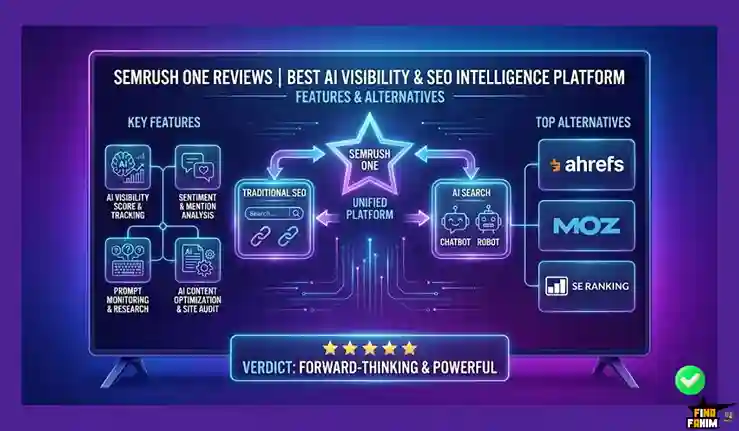
Traditional SEO tools—Ahrefs, Moz, and even the “Old” Semrush—cannot see this data. They can’t tell you if Perplexity recommends your product or if Gemini hates your customer service.
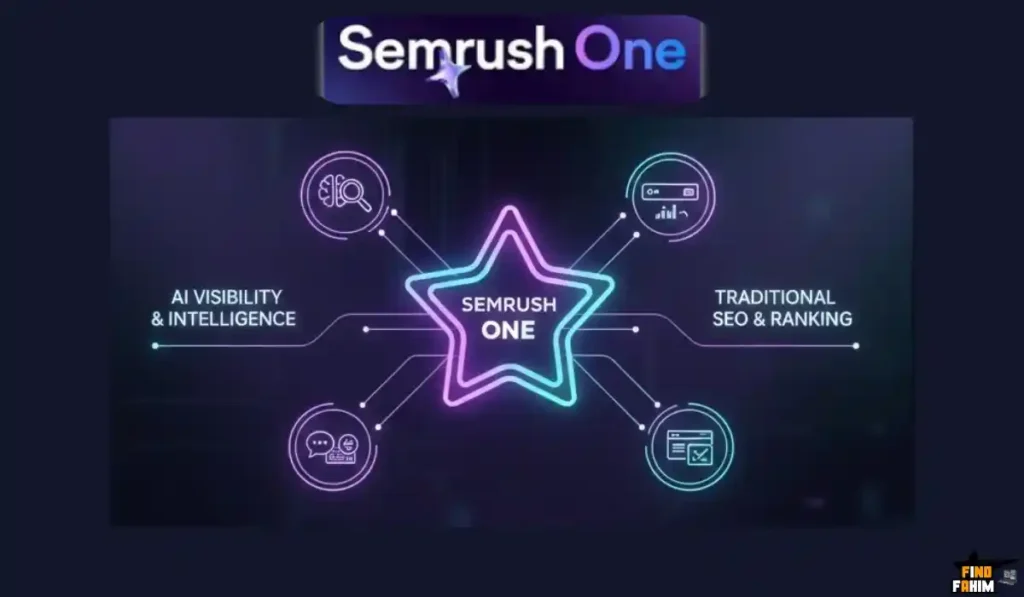
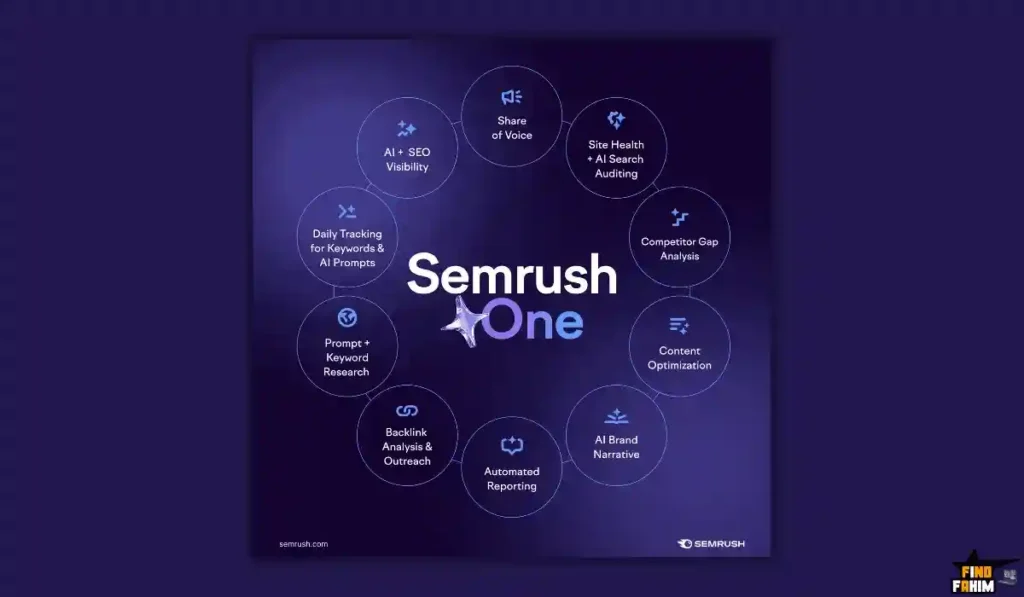
Semrush One was built to fill this void. It creates a new metric: “Total Visibility.” This aggregates your dominance on the Search Engine Results Page (SERP) with your “Share of Voice” inside the AI models.
Feature Deep Dive: The AI Visibility Toolkit
This is the star of the show. It is what separates Semrush One from every other tool on the market. Let’s break down exactly what it does.
1. The “AI Visibility Score.”
When you log in, you don’t just see “Organic Traffic” anymore. You see an AI Visibility Score.
This is a proprietary metric that calculates how often your brand appears in AI-generated responses compared to your competitors.
- The Benchmark: It shows you a direct comparison. “Your brand appears in 12% of AI answers for ‘Email Marketing’, while Mailchimp appears in 45%.”
- The Platforms: It pulls data from ChatGPT Search, Google AI Overviews, and Google AI Mode. Note: It currently focuses heavily on Google/OpenAI ecosystems.
Why this matters:
This is your new KPI. If your SEO traffic is flat but your AI Visibility Score is rising, you know your brand awareness strategy is working. It gives you a number to show your boss or clients to prove you are winning the “AI War.”
2. Prompt Research (The New Keyword Research)
This is the feature that blew me away.
In traditional SEO, we track “Keywords” (e.g., Best Coffee Maker).
In Semrush One, you track Prompts (e.g., “I want a coffee maker that grinds beans and has a timer, budget $200”).
The platform analyzes millions of anonymized interactions to show you the actual prompts users are typing into AI chatbots related to your niche.
- Intent Analysis: It tells you if the prompt is informational (“How does it work?”) or transactional (“Which one should I buy?”).
- Topic Clusters: It groups these prompts into themes, allowing you to see that 500 people asked AI about “Safety Features” while only 50 asked about “Color Options.”
Strategic Insight:
This changes your content strategy. Instead of writing a generic “Ultimate Guide,” you can write specific FAQ sections that directly answer the complex prompts users are feeding into ChatGPT.
3. Brand Sentiment & Perception Analysis
This is the scariest and most valuable feature.
The tool reads the AI’s answers about your brand and analyzes the Sentiment.
- Positive: “The AI recommends your tool as the industry leader.”
- Negative: “The AI cites a 2021 forum post complaining about your customer support.”
Real-World Example:
The agency Coalition Technologies used this feature for a client. They found that ChatGPT was describing their client’s outdoor gear as “outdated technology.” It wasn’t true—it was just military surplus style. But the AI misunderstood.
By spotting this Negative Sentiment in Semrush One, they updated their “About Us” page and homepage schema. Within weeks, they shifted the AI’s narrative from “Outdated” to “Classic/Durable.” That is the power of this tool. It lets you fix PR disasters that are happening inside the black box of AI.
4. Cited Sources Analysis
If you want to rank in AI, you need to be cited by the sources AI trusts.
But what are those sources?
This toolkit tells you. It gives you a list of “Cited Sources” for your niche.
- The Reveal: You might find that for your industry, ChatGPT trusts Reddit and LinkedIn more than it trusts the New York Times.
- The Action: This tells you exactly where to focus your off-site SEO. If Reddit is the #1 cited source for your keywords, you need to stop buying guest posts and start engaging in subreddits.
Feature Deep Dive: AI-Ready Site Audits
Technical SEO is no longer just about “making Google happy.” It’s about “letting the robots in.”
The Semrush One Site Audit tool has been upgraded with specific AI Crawler Checks.
It scans your robots.txt and server settings to ensure you are not accidentally blocking the bots that matter.
It checks for:
- ChatGPT-User (The bot that browses for users).
- OAI-SearchBot (OpenAI’s search crawler).
- Google-Extended (Google’s AI training crawler).
- PerplexityBot (Perplexity’s indexer).
- Claude-User (Anthropic’s agent).
Why this is critical:
I have seen major brands accidentally block GPTBot because they were scared of data scraping, not realizing they were also blocking ChatGPT Search visibility. This tool flags those issues instantly, ensuring your “Digital Front Door” is open to the new gatekeepers.
Why “Prompt Tracking” is the New Rank Tracking
We are all used to checking our “Rankings” every morning. Did we move from #4 to #3?
Semrush One introduces Prompt Tracking.
You can set up a custom list of prompts relevant to your business (e.g., “Compare Semrush vs Ahrefs for agencies”).
The platform will run this prompt daily across Google AI Overviews and ChatGPT and report back:
- Did your brand appear?
- Was it a citation (link)?
- Was it a mention (text only)?
- Who else appeared?
This is the only way to measure success in a world without traditional “Rankings.” You aren’t ranking #1; you are being “referenced.” This shift in mindset is what the platform facilitates.
The “Hybrid” Engine: Why Classic SEO Is Now “AI Fuel”
There is a dangerous myth circulating right now: “SEO is dead, so I don’t need keyword research anymore.”
This is completely wrong. In fact, classic SEO data is the fuel that powers AI results.
When ChatGPT answers a question, it doesn’t hallucinate facts out of thin air (hopefully). It browses the web. It looks for authoritative content that ranks well.
If you don’t rank on Google, the AI can’t find you.
Semrush One bridges this gap. It uses its legendary SEO database to ensure you capture the “Traditional Search” traffic while positioning you for “AI Discovery.”
Let’s look at how the classic tools included in this suite have been upgraded for 2025.
1. Keyword Magic Tool: The Foundation of Everything
You still get access to the world’s largest keyword database (25 Billion+ keywords). But in this new suite, you use it differently.
- The Old Way: Find a high-volume keyword like “best CRM” and write a blog post.
- The New Way: Use the Keyword Magic Tool to find the questions people ask. Then, feed those questions into the Prompt Research tool.
Why this integration matters:
You can spot a trend in Google Search data (e.g., rising searches for “CRM with AI writing assistant”) months before it becomes a popular prompt on ChatGPT. This allows you to create content that captures the “Early Adopter” wave on both search engines.
2. Personalized Keyword Difficulty (PKD%)
This is a feature most users miss, but it is critical.
Standard “Keyword Difficulty” (KD%) tells you how hard it is for anyone to rank.
Personalized Keyword Difficulty (PKD%) tells you how hard it is for YOU.
The platform analyzes your specific domain authority and backlink profile. It might tell you:
“The keyword ‘AI Marketing’ is Hard (80%), but for YOUR site, it is Easy (40%) because you already have authority in this niche.”
This prevents you from wasting time on impossible battles and highlights the “low-hanging fruit” that AI Overviews are likely to pick up.
The “Total Visibility” Workflow: How to actually use it
Having tools is one thing; knowing how to use them is another. Based on the strategies used by top agencies like Coalition Technologies, here is the 9-Step Workflow to dominating AI Search using Semrush One.
Phase 1: Benchmark & Discover
- Check Your AI Score: Open the Domain Overview. Look at your “AI Visibility Score” vs. your “Organic Traffic.” If your AI score is low, you are invisible to ChatGPT users.
- Run Competitor Research: Use the “Missing” filter to see topics where your competitors are cited by AI, but you aren’t.
- Identify Prompts: Go to Prompt Research. Find the exact conversational queries users are typing (e.g., “Compare [Your Brand] vs [Competitor] for small business”).
Phase 2: Create & Optimize
- Write “Citation-Worthy” Content: AI loves direct answers. Use the SEO Content Template to structure your articles with clear definitions (e.g., “What is X? X is…”) immediately after headings. This structure makes it easy for bots to “scrape and cite” you.
- Fix Brand Sentiment: Check the Brand Performance report. If the sentiment is “Neutral” or “Negative,” rewrite your “About” page and FAQ schema to clearly define your value proposition. Force the AI to understand who you are.
- Audit for AI Bots: Run a Site Audit. Check the “AI Search Health” score. Ensure you aren’t accidentally blocking OAI-SearchBot or PerplexityBot in your robots.txt file.
Phase 3: Amplify & Track
- Build “Off-Site” Citations: Look at the Cited Sources report. If Reddit is a top source for your niche, stop buying expensive guest posts and start answering questions in relevant subreddits. AI trusts Reddit; you should be there.
- Set Up Prompt Tracking: Add your top 10 most valuable prompts to the tracker. Treat them like your “Money Keywords.”
- Report to Stakeholders: Use My Reports to drag-and-drop your “AI Visibility” growth chart next to your “Revenue” chart. Prove that being cited by ChatGPT is driving real business.
Real-World Case Study: Fixing “Negative Hallucinations”
One of the most powerful use cases for Semrush One is reputation management inside the “Black Box.”
The Problem:
A client (an outdoor gear brand) noticed sales dropping. They couldn’t figure out why. Their Google rankings were fine.
Using Semrush One, they discovered that when users asked ChatGPT about their brand, the AI described their products as “outdated military surplus.”
This wasn’t true—they sold vintage-inspired modern gear. But the AI had “hallucinated” a negative attribute based on old forum data.
The Fix:
- They used the Sentiment Analysis tool to pinpoint the issue.
- They updated their homepage Schema Markup to explicitly state “Modern materials, vintage style.”
- They published a comparison article: “Vintage vs. Modern Gear: The Difference.”
- They tracked the prompt “Is [Brand] good quality?” in the platform.
The Result:
Within 3 weeks, ChatGPT updated its answer. The sentiment flipped from “Negative” to “Positive.” Sales recovered.
Without this tool, they never would have known why they were losing customers.
Industry Playbooks: SaaS vs E-commerce
Most reviews treat all websites the same. But Semrush One requires a completely different strategy depending on whether you sell software (SaaS) or physical products (e-commerce).
Here is the “Missing Manual” for your specific industry.
The SaaS Playbook: Winning the “Trust” War
If you are in B2B SaaS, your customers don’t just buy; they research. They ask ChatGPT, “Is [Tool A] better than [Tool B] for enterprise?”
The AI doesn’t look at your product page for the answer. It looks at Third-Party Trust Signals.
-
The “Documentation” Strategy
Recent data from the AI Visibility Index shows that LLMs heavily cite Product Documentation and Help Centers to understand what a SaaS tool actually does.
- The Mistake: Marketing teams hide documentation behind login walls.
- The Fix: Use the “Cited Sources” report. If you see competitors’ help pages being cited, you need to optimize your own. Rewrite your guides with clear “What is X?” definitions.
-
The “G2 & Reddit” Loop
For SaaS, the AI trusts G2, Capterra, and Reddit more than your blog.
- The Workflow: Go to Brand Performance -> Narrative Drivers. Look at the “Sentiment” drivers.
- Scenario: You might find that ChatGPT thinks your tool is “Expensive” because it scraped a 3-year-old Reddit thread.
- The Action: Create a “Pricing Comparison” page on your site that explicitly compares you to competitors. Then, use Prompt Tracking to monitor the prompt “Is [Your Tool] expensive?” Watch how the AI’s answer shifts over 30 days.
The Ecommerce Playbook: Winning the “Attribute” War
AI shopping assistants (like Google Gemini) don’t care about your “Brand Story.” They care about Attributes: Price, Material, Availability, and Use Case.
-
Fixing “Product Hallucinations.”
AI often lies about products. It might say your vegan leather boots are “Real Leather,” causing you to lose customers who want vegan options.
- The Diagnosis: Use Prompt Research to find “Attribute Prompts” like “Best vegan boots for winter.”
- The Audit: Check the AI Visibility Score for that prompt. If you are missing, the AI likely doesn’t know your product is vegan.
- The Fix: Use the Site Audit tool to check your Schema Markup. You must explicitly tag product attributes (Material: Synthetic) in your structured data.
-
The “Comparison” Trap
Shoppers ask AI: “Compare the Nike Pegasus vs. Adidas Ultraboost.”
If you are a smaller DTC brand, you are usually excluded from this conversation.
- The Strategy: You need to force the association.
- Action: Create a “Vs” page on your site: “[Your Shoe] vs. Nike Pegasus.” Use the Topic Research tool to find exactly what users hate about the Pegasus (e.g., “too narrow”).
- The AI Hook: Write a section titled “Why [Your Shoe] is wider than Pegasus.” When a user asks an AI for “Wide running shoes like Pegasus,” your brand is now statistically likely to be cited as the alternative.
The Agency Guide: How to Sell AI Services
If you run an SEO agency, Semrush One is not an expense; it is a new revenue stream.
Clients are terrified of AI. They are asking, “Why is my traffic dropping?”
You can use this tool to sell a high-ticket service: “Generative Engine Optimization (GEO).”
Here is exactly how to package and sell it.
Service 1: The “AI Visibility Audit” ($1,500 One-Time)
Stop selling “Technical Audits.” Clients find them boring. Sell an “AI Readiness Audit.”
- The Pitch: “We will analyze exactly what ChatGPT, Gemini, and Google AI think of your brand—and fix the negative hallucinations that are costing you sales.”
- The Deliverable:
- Share of Voice Report: Export the AI Visibility Overview graph showing them vs. 3 competitors.
- Sentiment Analysis: Show them the “Negative” red flags from the Perception tab. (Fear sells).
- Crawler Check: Show them if they are blocking OAI-SearchBot (The “Digital Front Door” check).
Service 2: The “Prompt Engineering” Retainer ($2,000/mo)
Traditional SEO retainers focus on “3 Blog Posts per Month.”
Shift this to “Prompt Optimization.”
- The Strategy: Instead of targeting keywords, you target the Top 50 Money Prompts found in the Prompt Research tool.
- The Work:
- Month 1: Create “Citation Hubs” (FAQs) for the top 10 informational prompts.
- Month 2: Build off-site citations on the “Cited Sources” (e.g., getting the client mentioned in a specific Wikipedia article or industry directory that the AI trusts).
- Reporting: Use My Reports to show the specific “Prompt Rankings” moving from “Not Cited” to “Cited.”
Semrush One Pricing: Is $199 Too Expensive?
Let’s address the elephant in the room: The Price Tag.
Semrush has moved upmarket. The days of the $99 “Pro” plan for everything are gone.
Semrush One is a premium suite, and the pricing reflects that. But is it value or just inflation?

Let’s break down the three tiers.
1. Starter Plan ($199/mo)
- The Deal: This is the entry point. You get the AI Visibility Toolkit and the core SEO Toolkit (Keyword Magic, Site Audit).
- The Limits: You can monitor 5 Websites and track 50 Prompts daily.
- The Verdict: Perfect for Solopreneurs and Small In-House Teams. If you manage one brand, 50 prompts are enough to track your core “Money Questions.”
2. Pro+ Plan ($299/mo) – The Sweet Spot
- The Upgrade: This adds Historical Data, Content Optimization (SEO Writing Assistant), and increases limits to 15 Websites.
- The Verdict: Mandatory for Growing Agencies. The historical data is critical for showing clients “Before & After” growth. Plus, 15 projects allow you to manage a decent client roster.
3. Advanced Plan ($549/mo)
- The Upgrade: Adds API Access, Share of Voice, and huge limits (40 Websites, 5,000 Keywords).
- The Verdict: For Enterprise and Large Agencies. If you need to build custom dashboards using the API, this is the only option.
Get Started with Semrush One Now
The “Hidden” Costs (Add-Ons)
Be aware that the base price isn’t always the final price.
- Extra Users: $45/mo per seat. (Teams, take note).
- Local Listings: $20/mo.
- Semrush.Trends: $289/mo (For deep market analysis).
The Financial Math:
Is it worth it?
If you bought separate tools:
- Ahrefs (Standard): $199/mo (SEO only).
- Profound (AI Tracking): $99/mo.
- Screaming Frog (Audit): $20/mo.
- Total: ~$320/mo.
Semrush One Starter ($199/mo) replaces that stack. You save $120/month while getting a unified dashboard. Mathematically, it is a deal.
Semrush One vs The Competition
This platform is unique because it competes on two fronts: Classic SEO and New AI Tracking. It is trying to be the “One Ring to Rule Them All,” but does it actually beat the specialists?
1. Semrush One vs Ahrefs
Ahrefs is the legendary rival and the industry standard for backlink data.
- Where Ahrefs Wins: Simplicity & Web Explorer. Their UI is cleaner and less cluttered. Their “Web Explorer” tool is fantastic for finding unlinked brand mentions across the entire web, not just in their index.
- Where Semrush Wins: AI Visibility. Ahrefs has zero features for tracking ChatGPT or Google AI Overviews. If you stick with Ahrefs, you are blind to the new search landscape. Also, Ahrefs has a notoriously restrictive “Credit” system that charges you for every report. Semrush allows unlimited reporting.
2. Semrush One vs Profound (Standalone AI Tool)
Profound is a niche tool specifically designed for AI visibility tracking (GEO).
- Where Profound Wins: Focus & Cost. It is cheaper ($99/mo) if you only want AI tracking and you already have an SEO tool you love (like Ahrefs). It is a specialized surgical knife.
- Where Semrush Wins: Integration. Profound doesn’t have a 25 billion keyword database. It doesn’t have a Site Audit tool. With Semrush One, you fix the technical SEO errors and track the AI results in one dashboard. It prevents “Tool Fragmentation.”
3. Semrush One vs Moz Pro
Moz is the “Legacy” option that many SEOs started with.
- Where Moz Wins: Beginner Ease. It is very cheap, and the metrics (Domain Authority) are the industry standard for measuring link power.
- Where Semrush Wins: Everything Else. Moz’s database is significantly smaller, and they have absolutely no AI visibility features. In 2025, Moz is hard to recommend for serious brands that need to track LLMs.
4. Semrush One vs SiteGuru
SiteGuru is a popular tool among the AppSumo community, known for its “Actionable Audits.”
- Where SiteGuru Wins: Actionability & Price. SiteGuru tells you exactly what to fix (“Add Alt Text here”) in a simple checklist format. It is perfect for small agencies or solopreneurs who find Semrush overwhelming. Plus, if you grabbed the SiteGuru Lifetime Deal (check my SiteGuru review for details), it is infinitely cheaper.
- Where Semrush Wins: Deep Data. SiteGuru is an Auditor; Semrush is a Visibility Engine. SiteGuru can fix your meta tags, but it cannot tell you what ChatGPT thinks of your brand sentiment or track 5,000 keywords daily.
5. Semrush One vs SE Ranking
SE Ranking is the aggressive “Budget Challenger” that offers a similar suite for a lower price.
- Where SE Ranking Wins: Price-to-Value. You can get a very capable SEO suite for ~$50/mo. For agencies on a tight budget, it covers 80% of what Semrush does for 30% of the cost.
- Where Semrush Wins: The “Premium” Layer. SE Ranking is great for Google SEO, but it lacks the advanced AI Visibility Toolkit found in Semrush One. It doesn’t track prompts or LLM citations yet. If you need to sell “AI Optimization” services to high-ticket clients, you need Semrush One.
The Ultimate Comparison Matrix
| Feature | Semrush One | Ahrefs | Profound | SiteGuru | SE Ranking | Moz Pro |
| Best For… | Total Search Visibility | Backlink Research | AI Tracking Only | Technical Audits | Budget Agencies | Beginners |
| Pricing | $199/mo | $199/mo | $99/mo | ~$29/mo (or LTD) | ~$55/mo | $99/mo |
| Classic SEO | ✅ World Class | ✅ World Class | ❌ No | ✅ Audit Only | ✅ Good | ⚠️ Basic |
| AI Visibility | ✅ Full Suite | ❌ No | ✅ Full Suite | ❌ No | ❌ No | ❌ No |
| Prompt Tracking | ✅ Yes | ❌ No | ✅ Yes | ❌ No | ❌ No | ❌ No |
| Reporting | ✅ Unlimited | ⚠️ Credits | ✅ Unlimited | ✅ Unlimited | ✅ Unlimited | ✅ Unlimited |
| My Verdict | The Future Proof Choice | The Backlink King | The AI Specialist | The Actionable Audit | The Value King | The Legacy Choice |
Final Verdict: Is This The Future of SEO?
After testing Semrush One extensively, my verdict is a 4.8-Star YES.
This is not just a “feature update.” It is a fundamental shift in how we do marketing.
- If you ignore AI: You will lose market share to competitors who are optimizing for ChatGPT.
- If you buy this tool: You get a “Head Start.” You will be the first in your niche to optimize your “Brand Sentiment” and dominate the “Cited Sources” list.
Who Should Buy It?
- Agencies: It is a no-brainer. Selling “AI Optimization Services” is the easiest upsell in 2025. This tool gives you the reports to back it up.
- E-commerce Brands: Use it to fix “Product Hallucinations” and ensure ChatGPT recommends your store.
Who Should Skip It?
- Hobby Bloggers: If you can’t afford $199/mo, stick to Google Search Console and free tools. This is a pro-grade weapon.
Get Started with Semrush One (7-Day Free Trial)
About the Author
I’ve been in SEO since the “Keyword Stuffing” days of 2010. I’ve watched algorithm updates kill entire businesses overnight. I’ve seen brands lose millions in traffic from a single Google penalty. The “AI Shift” we’re experiencing right now is the biggest, most fundamental change I’ve witnessed since Mobile-First Indexing dropped back in 2016.
I use Semrush One every single day because I refuse to be obsolete in this industry. I refuse to wake up one morning and realize my entire skill set is worthless. I want to know exactly what the bots are saying about my clients behind the scenes, and right now, this is the only tool on the market that actually tells me. There’s nothing else that gives me visibility into the AI black box where my customers are making decisions.
FAQ: Your Semrush One Questions, Answered
Semrush One is the upgraded flagship bundle that includes the AI Visibility Toolkit for tracking ChatGPT Search, Google AI Overviews, and other AI platforms. The older Semrush Pro plan lacks these advanced AI tracking features.
Yes. Semrush One tracks visibility on ChatGPT Search, Google AI Overviews, Google AI Mode, Gemini, and Perplexity. It measures citations, mentions, ranking prompts, and sentiment.
Yes, Semrush One offers a 7-day free trial that lets you test the Starter or Pro+ plan before being charged.
The Starter plan tracks up to 500 keywords and 50 AI prompts daily. The Pro+ plan allows 1,500 keywords and 100 prompts for expanded tracking.
Yes. The Site Audit tool identifies errors in robots.txt or server settings that may block AI crawlers such as OAI-SearchBot or PerplexityBot.
Yes. Current Semrush users can upgrade directly from their dashboard while keeping all project data and tracking history intact.
API access is only included in the Advanced Plan. Starter and Pro+ do not offer API capabilities.
It is a domain-specific difficulty score that estimates how challenging it would be for your exact website to rank for a keyword based on your current authority.
Yes. You can add additional user seats starting at $45 per month. All base plans include one seat by default.
Most Semrush databases update daily, weekly, or monthly depending on the metric. Rank tracking and AI prompt tracking update daily.
A low AI Visibility Score means AI models rarely cite or reference your brand. Improving your score requires better topical authority, more direct-answer content, and positive mentions on trusted third-party platforms.
Yes. Semrush data shows AI-driven traffic can be up to 4.4× more valuable than traditional search traffic due to higher user intent.
Yes. Semrush One lets you compare competitor visibility across ChatGPT, Google AI Overviews, Gemini, and Perplexity and find Topic Gaps where your brand is missing.
For most marketers, yes. Semrush One covers keyword research, backlinks, site audits, and adds AI visibility tracking, which Ahrefs does not currently offer.
A prompt is a conversational query users type into an AI tool, such as 'best running shoes for flat feet.' Semrush One tracks your visibility for these prompts similar to keyword rankings. What is the difference between Semrush Pro and Semrush One?
Does Semrush One track ChatGPT?
Is there a free trial for Semrush One?
How many keywords can I track with Semrush One?
Does Semrush One check for AI crawler blocks?
Can I upgrade my existing Semrush account to Semrush One?
Does Semrush One include API access?
What is Personalized Keyword Difficulty?
Can I add more users to Semrush One?
Is Semrush One data updated in real-time?
Why is my AI Visibility Score low?
Is AI traffic valuable for SEO?
Can I track my competitors' AI visibility?
Does Semrush One replace the need for Ahrefs?
What is a Prompt in Semrush One?

Hi, I’m Fahim — a SaaS tools reviewer and digital marketing expert with hands-on experience helping businesses grow using the right software. I research, test, and personally use a wide range of AI, business, productivity, marketing, and email tools for my agency, clients, and projects. I create honest, in-depth reviews and guides to help entrepreneurs, freelancers, startups, and digital agencies choose the best tools to save time, boost results, and scale smarter. If I recommend it, I’ve used it — and I only share what truly works.